
HOW TO GROW RANUNCULUSES Experiments in growing these great flowering bulbs.
Of all the bulbs I've grown, the ones that provide the longest, richest profusion of flowers, are the cheapest to buy, and the easiest to plant and grow are ranunculuses.


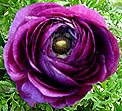



This page chronicles my experiments to find out the best way to grow and propagate these bulbs. (Actually, they are a tuberous root, though some people call them tubers. I'll use tubers on this page because it's easier to type.) After presenting some general cultural guidelines, this webpage consists of a series of questions about growing ranunculuses followed by the experiment used to answer each of them. Reading through these questions and answers should provide anyone a good idea of how to grow and propagate ranunculuses.
Here are some of the reasons I like ranunculuses:
They're cheap: I can get a bag of 40 tubers for 2 dollars at Wal-Mart. That's many times cheaper than almost any other bulb. (Note: by the Fall of 2009 the cost increased to $5 for 30 tubers, still the best bulb buy.)
They are easy to plant: Unlike many bulbs that have to be planted 6 inches deep, ranunculuses only need to be placed 1-2 inches beneath the surface. This is a real back saver if you're planting a large bed.
Easy to grow: I've gotten great results just pushing the tubers into the soil with no special care. They're tough enough to survive light frosts, bright sun, mild dry spells and neglect.
Fast propagation: Bulbs like tulips, daffodils, and gladiolas only double or triple the number of bulbs that can be collected and made to flower the next season. It's not unusual to get eight new tubers from a single ranunculus in one year.
Early greenery: Planted in Fall, ranunculuses quickly sprout and provide winter-long greenery. Most other bulbs just sit in the ground without any top growth.
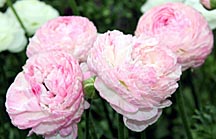
They provide one of the largest ranges of colors available in any bulb: As the pictures above and further down this page show.
The flowers are beautiful both in color and form.
The flowers resist frost damage so a late cold snap won't wipe out the bed.
They make great cut flowers: A ranunculus flower can last over a week after being cut.
With a list of
advantages as long as this it makes good sense to plant ranunculuses,
so shall we get started?
General Ranunculus Growing Techniques:
Plant the tubers, which look like bunches of miniature dried bananas, in Fall.
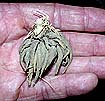
A
typical ranunculus tuber. The cheap ones available
at
Wal-Mart stores are small but still produce good results if
planted
in Fall and allowed to grow all winter in a
mostly
frost-free, sunny location.
In my high desert location I plant them against a south facing wall where they are protected from frost and get plenty of light. In locations with very hard frosts or snow they need to be planted in Spring. Ranunculuses prefer cool weather and full sun. Plant them 1 to 2 inches deep in average, well drained soil. (If the soil has standing water an hour after turning the sprinklers off they would do better in a faster draining location.) Fertilize with bulb food at planting time, when they start to flower, and once more when the flowering is over (to encourage the development of large and plentiful tubers.) Be careful to not let any of the fertilizer come in direct contact with the tubers or the foliage or it may burn them. Space small tubers three inches apart and very large ones, which may actually be a collection of several tubers tangled together, eight inches apart. (The first flowers appear around 1 March in my high desert location and the plants flower profusely for five to six weeks. Remove spent blooms to encourage a longer flowering time. Once the flowering is over, cut the flowering stems off as close to the plant as possible but don't trim any off the main foliage. The stems can be left on but it makes the plant look sloppy. Cutting the stems cleans up their appearance. Continue watering until the plants die back to the ground (usually 2 -3 months later) and then let the soil go dry. Avoid watering while the tubers are dormant or they may rot. The tubers can be left in the ground until Fall when they should sprout again. (Because they have multiplied, leaving them in the ground as is may result in crowding that could weaken the individual plants.) The tubers can also be dug, once the tops die back, separated, dried, and stored for planting later in the year. Digging them frees up the area for other plants and avoids problems with rot. It also allows you to divide and replant them at optimal spacing.
Those are the basics of ranunculus culture gleaned from my own experiences and reading through several sites about ranunculuses on the Internet. What follows are questions I had about ranunculuses and how I answered them.
Questions
and Answers:
I read on one webpage that ranunculuses do best in situations where the tuber is kept on the dry side while the roots are kept moist. Does this improve flower production or tuber growth?
Answer: I grew one patch of similar sized tubers in normal soil and another topped with quick-draining sand and compare the results. All other aspects of growth like planting depth, sunshine, water, and fertilization was the same. Plant size, number of flowers, size of flowers, and size of roots were the same for both groups so planting them in sand didn't make any difference in this test.
What
is the best way to separate tubers?
Answer: I found that freshly dug ranunculus tubers are so fat with moisture that they're brittle and easily broken. Tearing them apart can severely damage them because their tangled roots are locked together. Letting them dry for a week before separating them is better, but by then, at least in my low humidity location, the tubers are so dry they are again brittle and easily broken, just like when they were too fresh. (Can't seem to win with these guys.) The safest time I found to pull them apart was after 24 to 48 hours of drying in a shaded location. At this time they still have enough moisture so that they bend a little instead of breaking yet have shrunk some so they are loose enough to divide. Individual clumps of tubers are easily identified within each cluster.
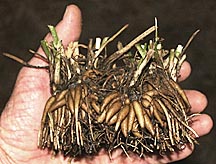
A freshly dug
cluster of ranunculus tubers that started
off 9 months
ago as a single small tuber.
Grab the main cluster with one hand and the clump to be pulled away with the other and with very small twisting and rocking motions ease the two apart. You'll be able to feel them twist relative to each other if they are going to come apart. If they feel locked solid I recommend leaving them as a single clump rather than risk damaging them.
Can
large clusters be cut apart with a knife or forcibly ripped apart
and still flower?
Answer: I cut or tore a couple of tubers in half and each piece grew fine. I suppose there's a limit, small tubers can't be divided down to individual fingers.
If
an individual tuber (one miniature
dried banana) is
planted, will it grow?
Answer: I planted a dozen of these and not one of them sprouted so I'm concluding this does not work.
Do
the tubers collected from one plant grow into plants that all have
the same foliage shape and flower type?
Answer: Tubers collected in the Spring of 2005 were bagged so that only the tubers from one plant went into each bag. In Fall of 2005 I planted the contents of each bag in a solid group and marked each group so that the results could be tracked. Although frosts cause the foliage to take on a shredded appearance that makes determining differences a challenge, I would say that the foliage from tubers that came from the same plant is the same. In particular, one plant yielded four tubers that all produced the same variegated pattern of dark markings on their leaves. Flower colors and forms were also the same.
How
many solid colors do ranunculuses come in?
Answer: The 2003-2004 planting of two different mixes produced nine different solid colors:
white
yellow
orange
red
a
weird red (looked like it had some dark magenta in it)
light
pink
medium
pink
dark
pink
purple
A 2009 planting of 180 cheap mixed ranunculuses turned up an attractive pale yellow, a greenish lemon yellow, a very soft striped pink and an unattractive but interesting plant with the top side of the petals a ruddy yellow and the undersides a dark orange. I kept the yellows and pink for next year.
What
happens if a very large cluster of tubers is planted as a single unit
versus being separated and planted over a larger area?
Answer: I took two tubers that were the same size and planted one whole and the other divided into four pieces. They both produced about the same number of flowers but the divided bunch produced a more even, pleasing appearance and the plants were better able to support each other.
Does
it help or hurt to soak ranunculus
tubers in water before planting? How long should they be soaked?
Answer: Soaking in water for 14 hours caused one or two of the fingers in a large cluster to swell and split, the rest appeared unhurt. Wrapping clusters in a wet towel didn't cause any problems. I noticed that tubers rehydrated either way were much easier to handle and plant than dry tubers, which were brittle and tended to break. Soaked tubers aren't soggy, they are plump and firm. They all sprouted, grew and flowered about the same.
Do
high priced jumbo ranunculus tubers
grow larger and better than the small cheap tubers available in
department stores?
Answer: Yes, but not much. The premium tubers I personally hand picked directly at a ranunculus farm averaged three times the size of the cheap ones from Wal-Mart. But once in the ground they performed about the same. The jumbo tubers produced plants that were 20 percent larger and had a few more flowers, but the difference wasn't worth the five-times increase in cost. I've read reports that the jumbo tubers should significantly out perform the smaller ones. Perhaps this was comparing tubers planted in Spring. With Fall planting the plants from the small tubers have enough time to catch up to their heavy-weight brothers. The germination rate (about 60 percent) was the same for both jumbo and small tubers.
How
frost
tolerant are ranunculuses?
Answer: In my high desert location (very clear, still, low humidity nights) I noticed that the plants can withstand temperatures down to 28 degrees with no damage. At 25 degrees the tips of the leaves of a few plants will turn dark and shrivel, and at 22 degrees 1/4 of the plants will show some minor frost damage. However, they all quickly recovered.
On clear nights, which is typical where I live, plants can radiate heat away at night and actually become colder than the air. People living in cloudy, more humid locations my find that ranunculuses can survive lower air temperatures than mine can.
Do
Ranunculuses produce seeds?
Answer: Yes!

If the flowers aren't cut off when the petals fall off, as shown above, in a few weeks the remaining seed head matures and dries out to look like this:

Each individual tuft is a seed seen edge on. Rub the pod between your fingers and the seeds tumble off by the hundreds or even thousands.
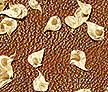
Each seed is 1/8-inch across. The pointed end of the paper husk is what points outward from the pod, creating the pod's prickly look.
The question is weather these seeds will germinate. To answer this I'll be planting several hundred in the Fall of 2006. Check back around November and I post the results.
Fall,
2005, Planting Season:
The season started in October with preparing the bed. I decided it was time for a major overhaul so I worked 20 cubic feet of compressed peat moss, 100 pounds of alfalfa pellets, 55 pounds of kelp meal, 20 pounds of organic 5-5-5 fertilizer, and 15 pounds of bone meal into the top 16 inches of soil. This may have been too much because the bed heated up to 110 degrees from all that organic matter composting. After a week it cooled down and I was able to start planting.
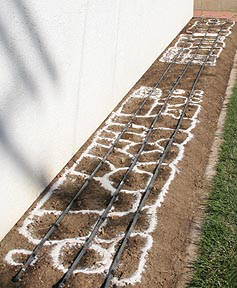
Planting day this year was on October 30. The daily temperatures were averaging 72 degrees, calm, clear, with very bright sunlight. I used white sand to outline each planting area to help keep things straight for the many different experiments being conducted. Each area is filled with tubers harvested from one particular plant from last year's crop.
The weather remained warm and sunny and by 8 November, nine days later, the first sprouts appeared.

The planting map tells me that these are white ranunculuses.
Besides verifying that all the tubers from one of last year's rhizomes produce the same colored flowers, it'll also be interesting to see if they also produce the same type of foliage. Ranunculuses vary considerably in the type of leaf shape: some are potato-leafed, others are finely cut like celery leaves.
Here's what the bed looked like a month later on the first of December:
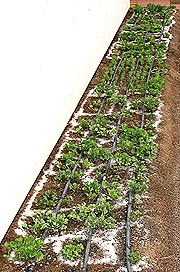
The germination rate is almost 100-percent. The only difference between this year and last, which only had a 60-percent germination rate, is that the peat moss added to the soil this year reduced it's PH from alkaline to slightly acidic. Perhaps ranunculuses prefer more acid conditions.
By the beginning of February the bed had filled in very nicely.
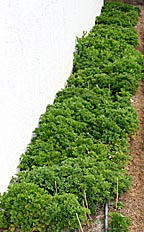
The plants are 9-inches tall, very full and dense. I'm getting a little concerned that they may be a little too crowded. Still, all the amendments added to the soil should provide enough nutrients to support them.
The leaves come in two main shapes:
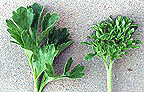
what I can "potato-leafed" on the left and "celery-leafed" on the right. Variations part-way between these two forms are common.
On 1 March I spotted half a dozen good-sized buds. On March 12 the first flower, a red one, opened. For me the first ranunculus flower declares that Spring has officially started.
The bed hit its peak on April 15.

It provided one-hundred square feet of pure color for almost a month. By the first of May the flower count had dropped but due to cool weather late in the year, for my high-dessert location, the bed still looks good.
I always plant several dozen inexpensive, mixed bags of ranunculuses because while they may not be as good as the top of the line Tecolate varieties, they offer more variation of flower colors and shapes.
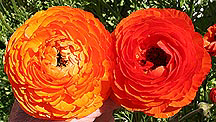
For example: this year I got both light and dark orange varieties...
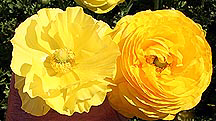
...as well as light, open yellows and tight, darker yellows.
I mark the plants I like and save their roots for next year.
2009 SEASON!!!
This page was written back in 2004-2005. Since then I've noticed a sad decline in the popularity of ranunculuses. Back then home improvement stores like Home Depot carried a wide range of purchasing options: different size bags of mixed colors and the full range of individual tecolote colors. Wal-mart carried large bags for just two dollars. In 2009 the pickings are much slimmer. Wal-mart doesn't carry any and Home Deport only sells small bags of mixed colors, and these are the very poorest quality and don't contain as many tubers as they state are in the package. Finally, they weren't locally available until late December, far too late for a good Fall planting.
To purchase good tecolote ranunculuses I had to go on-line and pay $10 for ten tubers. (Besides being scarcer, their cost has also doubled in the last 4 years.)
Since I'd taken a break from ranunculuses all my tubers were long gone. I decided to restock with ten each of red, yellow, gold salmon, pink, purple, sunset (orange), white and rose top-quality tecolotes as well as 180 mixed tubers from Home Depot. The mixed planting won't produce as high a quality of plants and flowers this first year, but as I mentioned before such mixtures always provide interesting and unusual colors worth saving for the following year.
I prepared the 100 square foot bed by forking in 12-pounds of bone meal, 8-pounds of blood meal, 50-pounds of alfalfa meal (a rich source of nutrients and growth hormones) and 4.4 cubic feet of compressed peat moss (7 cubic feet uncompressed.) After triple forking to make sure everything was thoroughly mixed in I raked it smooth, walked it down to push most of the air out (forked soil, like rototilled soil, has so much air in it that when watered some areas collapse while others remain high and dry. Walking the soil flat when it's dry doesn't compact it.) Then I raked it flat again, watered it in with 2-inches of water by hand, let it settle, raked it smooth a third time, then finally used a board and potting soil to screed it table-flat. A final hand watering followed by a few more handfuls of potting soil to level low spots and the bed was as level as a billiard table. This arduous process ensures that water will settle evenly and not flow into low spots.
The fun began on 7 January: planting. It took a good two hours to push the 270 tubers into the bed. Now all I have to do is sit back and watch them grow.
I expect flowers to appear much later than the middle of March as they did with Fall planting because they were planted two months later and because this bed only gets sun morning till noon.
Sprouting! The first sprouts appeared on 31 January, 24 days after planting. This is 2 and 1/2 times longer than the 2005 October planting against the south wall. But then the temperatures averaged 20-degrees colder and the bed gets less than half the sun.
First Flowers! The ranunculuses began flowering in mid-April and by 2 May the bed had reached full bloom.

There are blank spots in the bed because I forgot to plant extra plants that could be moved into open areas. I admit that this bed isn't as luxuriant as a good ranunculus bed should be, but then this is really a seed bed; one intended primarily to build up a collection of tubers for the following year. I was disappointed in the tecolate tubers (left half of the bed) because in both flower size and shape they weren't as impressive as the tecolates I got from the bulb farm in San Diego a few years back. Still I was fortunate to discover a couple of nice surprises in the cheap mixed tubers (right side of the bed) because in addition to both light and dark oranges and hot pinks there were three interesting flowers that are definite keepers for next year: a very light yellow,
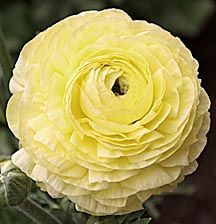
an even lighter yellow with a hint of lemon green
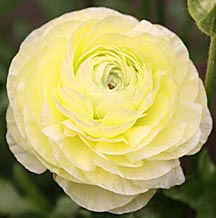
and a slightly mottled light pink that looks great from a distance.
By 18 May 60-percent of the ranunculuses had lost their flowers and it was time to trim the flower stems so the bed looked halfway presentable. The bed only looked good for three weeks because the temperatures got into the 90s early in May. The late planting and early hot weather weakened the plants so much that I was able to harvest only 220 tubers, many of which were extremely small. On the up side, I got two new yellows, an interesting striped pink, a reddish-pink, and a tangerine orange, all of which I hope to increase during the 2009-2010 season. I'm also planting more assorted ranunculuses to see what other new colors turn up.
I will be planting the 2010 bed around the middle of October so they will get off to a much earlier start. Hopefully the longer growing season will result in earlier flowering before summer's heat arrives. The problem with this plan is that I'm 200 tubers short for planting a respectable bed. With prices way up I was apprehensive about what they were going to cost me. Ordering top-quality Tecolate tubers would cost several hundred dollars and this late in the season most of these would be over a year old. (Most ranunculuses in the USA are harvested in July, allowed to dry, processed in August and available for sale no sooner than September.) After two hours searching the Internet I was fortunate to find that van Bourgondien Bulbs (www.dutchbulbs.com) was having a clearance of their 2009 tubers. By ordering 12 packs of 20 tubers the cost per tuber was only 13-cents. This was half the cost of anyone else's. When they arrived I was delighted to discover that they were healthy and uniformly sized with no broken, crushed or undersized tubers. Combined with the tubers harvested from the 2009 bed, I have 460 ranunculuses. That should be enough for a good bed. Please be sure to check back during April of 2010 to see how the bed looks.
2010 BED IS PLANTED!!!
TUBER PURCHASING UPDATE:
Unlike last year, the 2009/2010 Fall season has stores selling many more ranunculuses. During the last week in September I found 25 and 75-tuber bags for sale in Home Depot for $4 and $10 respectively. Walmart carried 30-tuber bags for $5. Unable to resist, I grabbed all I could see and ended up with 400 tubers. I topped those purchases off with 16 packages of tubers from the world famous ranunculus fields in Carlsbad California. It's beginning to look like Spring of 2010 is going to be very colorful.
The 2010 season started on October 15 of 2009 with planting the tubers in the bed against the east-facing wall used in the 2009 season.
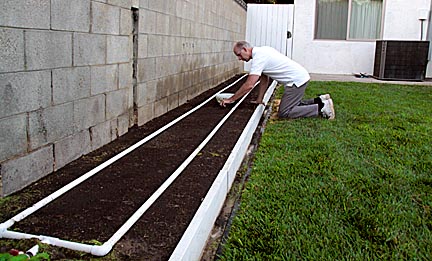
The
bed is actually twice as long as the 30 feet pictured here. It's the
largest ranunculus planting I've ever undertaken.
I dug 100 pounds of alfalfa meal and 20 pounds of organic 10-10-10 pelleted slow release fertilizer into the top 12 inches of the bed. Then I raked it level, walked and raked it level again (the soil was dry so compaction wasn't an issue,) hand watered it with one full inch of water, let it settle, leveled it with sifted garden soil, and finally watered it again to settle the new soil. This provided a perfectly level bed so that water run off won't be a problem. The tubers were planted by using a spoon to scoop a shallow hole, the tuber pushed in and the hole covered. Planting, not counting the time preparing the bed, took three hours.
I used tubers from five different sources and planted them in individual plots to compare how they do.
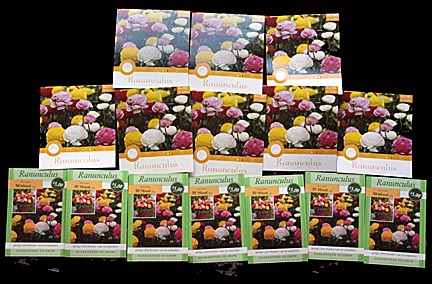
From Home Depot I got 8 bags of tubers containing 25 tubers each while from Walmart I purchased 7 bags with 30 each for a total of 410 tubers.
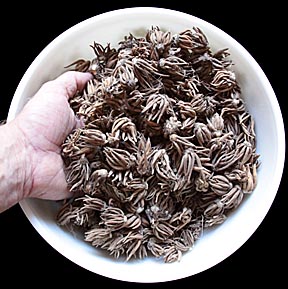
Here's
what 410 ranunculus tubers look like. It's hard to believe that
these dried-out,
drab
roots will be exploding with the brightest colors in the garden in
just a few months.
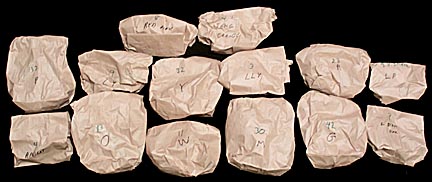
Next came 220 tubers harvested from the 2009 garden. I don't have much hope for these. Grown over a very short season the tubers were extremely small and shriveled. If any sprout I'll be surprised.
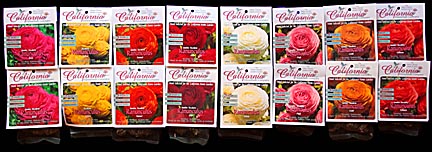
The kings of the bed are the 16 hand-picked bags of tubers purchased directly from the ranunculus fields in Carlsbad, California. Although this represents only 80 tubers, they promise to provide the best show. They'd better, at $.75 per tuber I feel I have the right to expect a lot, though previous comparisons showed they are only 20-percent better than cheap bulbs when planted in Fall.
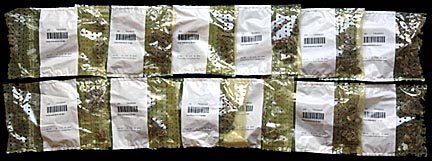
Finally, I finished off the bed with 240 tubers purchased on-line from van Bourgondien Bulbs. After working with the premium tubers from Carlsbad and even the cheap ones from Walmart I have to revise my opinion of these tubers downward. They were really quite small.
In addition to these 958 tubers, I also purchased 235 stand-by tubers from Home Depot to fill in where any planted tubers fail to sprout.
Sprouting!
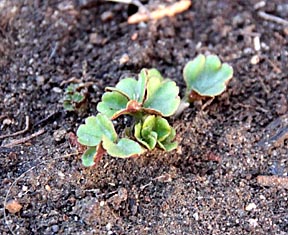
The first sprouts appeared on October 26, 11 days after planting. This is two days later than the planting in the bed with a southern exposure. I assume this is do to the new bed's lower average temperature. The sprouting is progressing very unevenly, with many tubers not showing any green even after three weeks. This doesn't concern me because late sprouters will have the entire winter to catch up.
To my pleasant surprise, 95-percent of the poor quality tubers harvested earlier this year sprouted. On the down side, so far not one of the expensive, hand-picked tubers purchased in Carlsbad has sprouted yet. Since they appeared to be in excellent condition, I'm concerned I may have let the bed dry out too much and in so doing killed them. Only time will tell.
Ranunculus
Transplanting:
It is inevitable that somes tubers planted in mid October won't sprout. Planting replacement tubers in empty spots helps fill in the bed, but the new tubers will be six weeks behind the first planting. The first planting not only has six more week's of growth than the replacements, they also have this growth during much warmer and sunnier weather. These two factors have the effect of giving the first planting effectively over two months of additional growth. In as much as the total time to flowering is only five months, this represents 40-percent more growing time, enough to have a major impact on plant size, flower count and harvested tuber size. On top of this, many of the replacement tubers will also fail to sprout.
The obvious solution to delayed growth and planting tubers that fail to sprout is to plant all the replacement ranunculuses in an unused bed at the same time as the main planting, then transplant them into the main bed after six weeks time.This insures that only live tubers go into the main bed and eliminates the six week delay in their growth. The questions to be answered are: Can ranunculuses be transplanted and how large a root ball needs to be dug up for each tuber?
To answer the first question, I dug up a ranunculus and moved it to a different location to see how well it takes disturbing its roots. I'll report the results in early December.
As to how large a root ball is required for transplanting, I dug up a healthy looking plant and slowly pared down the root ball to disclose the shape and extend of its root system.
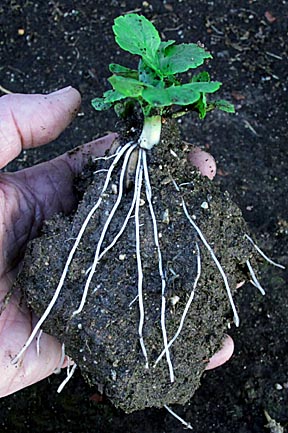
After two weeks of growth, the top on this specimen was an inch and a half (4 cm) tall. The roots extended downward in a cone five inches long and three wide at the base. This indicates that when digging ranunculus transplants, besides doing so when they are as young as possible, it is best to dig a deep root ball rather than a fat round one.
Taking
A
Closer Look At Ranunculus Roots:
I had always thought that ranunculus roots sprouted from the tips of the fingers that make up the tubers. This is not the case, as the following image shows:
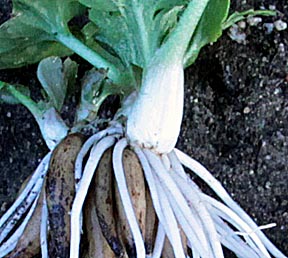
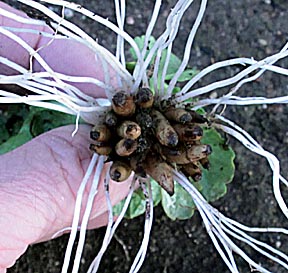
The roots actually grow outward from the base of a sprout on the top of the crown. I suspect that this growth pattern is similar to that of dahlias, where the large root bulbs are food sources that feed an "eye" that is the site of new growth.
Since the roots extend outward from growth spots on the top of the tuber, it's not surprising that they spread out from the top of the tuber like a crown instead of downward from between the fingers.
November
13 Update:
I would never have believed that the spindly, dried-out tubers harvested from last year's bed would out perform all the other ranunculus tubers. 217 of the 220 home-grown tubers sprouted for an incredible 98.6-percent viability. In comparison only 60-percent of the Home Depot/Walmart tubers sprouted, 70-percent of the expensive tubers from Carlsbad came up and a measly 10-percent of the mail order tubers from van Bourgondien Bulbs produced plants. Equally amazing was that my tubers produced plants that are more then twice as large as those from purchased tubers.
I believe the reason is that unlike commercial tubers, which are mechanically harvested and separated, mine were gently dug and teased apart by hand. The rigors of mechanical separation may damage the growth eyes whereas all the eyes on mine were untouched.
As a side experiment, I attempted presprouting tubers by wrapping them in damp paper towels sealing them in a plastic bag. It failed. Mold covered them before they sprouted.
The weather has turned cold with highs in the low 60s and nighttime lows near freezing. As expected, top growth has slowed but the roots are still active, establishing the foundation for strong plants next Spring.
NEW!!! March 16, 2010 Update:
Four months have passed and I'm happy to say that in spite on many hard frosts in the low 20s the ranunculus bed has flourished.
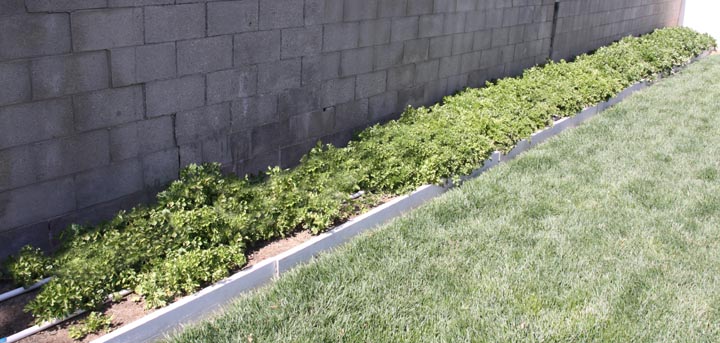
At 45-feet long, it's twice as long as the 2009 bed and with a much better fill promises to put on a great show. The first flower buds appeared on March 11. I anticipate that the first flowers will open around the end of March or the first of April, two to three weeks earlier than the 2009 planting in January. I must confess it's disappointing that three months extra growing time only produced flowers a couple of weeks earlier. But then the flowering may be triggered more by day length than any other factor so planting date is unimportant. Hopefully the much larger and robust plants will produce more flowers than last year's spindly plants, as well as larger tubers for the 2011 season. Even if the bed hits its peak only three weeks earlier than beds planted in January, it could make an enormous difference in the longevity of the flowers. By early May, when last year's bed hit its peak, temperature in my high desert location can top 90-degrees, which is difficult for these cool weather plants to endure.
Starting March 1, I began fertilizing with two tablespoons of Miracle Grow's Bloom Booster plant food per every 12 square feed of bed once a week. I have no way of knowing if this will hurt of help blossom size, count or tuber production rate. For next year I plan to sort the tubers by size and plant several test beds to compare different fertilizing methods to determine how they affect flower and tuber size. But that's a year away. Now it's time to sit back and whach the show unfold.
April 10 Update:
The first flower opened on March 20 and by April 10 the bed looked like the following:
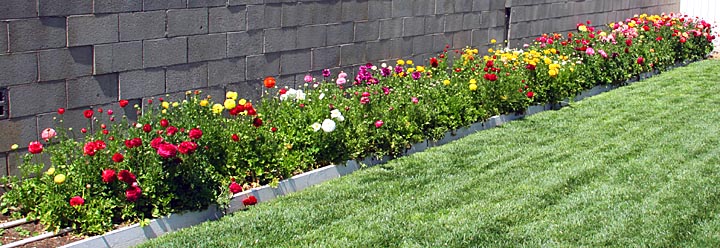
There are hundreds of unopened buds so this is no where near the peak.
The mixed tubers from Wal-mart and Home Depot, on the far right, are very disappointing. Almost all of them are unattractive bicolors and not fully double so they don't show the ideal tight rosette of petals. The expensive tubers from Carlsbad are equally disappointing. Although their shape and colors are better, their low germination rate and they fact that each color had a few off-colors mixed in was not what I expected considering the price paid for them. So few of the van Bourgondien tubers grew that it's impossible to make any judgements about the quality of the flowers they provided. On the other hand, the tubers saved from last year's garden are for the most part pure colors with perfect flower shape.
I've formed several conclusions from this ranunculus bed. First, I can't count on purchased tubers having high germination rates. The only way to achieve anything close to 100-percent is to harvest my own tubers. Second, paying top dollar for tubers doesn't not insure they will produce the flowers you expect. Some will be the wrong color while others won't have top flower shape. Third, mixes contain mostly poorly colored and shaped flowers. Cultivating my own tuber ensures that I have the best colors and shapes.
The consequence of these considerations is that from now on I'll only rely on tubers grown in my own garden. This has the added benefit of enabling me to develop my preferred mix of colors. For example, although purple might be nice for extending the range of the color pallet, it's so dark that it doesn't take many of them to inject a somber note to a bed. Besides, their dark color absorbs so much heat from sun light that they fade quickly. Most mixes contain far too many magenta flowers and not nearly enough light pink, white, orange and red. While light yellows are interesting, they tend to get lost in mixed beds. Buttery yellows or golds stand up better against the other colors.
For next year I'll be saving tubers from all the plants that produced top quality flowers in equal proportions of white, butter yellow, orange, light pink, red and just a few magentas.
April 17 Update:
The bed hit its peak on April 17, two weeks earlier than last year's late planting in January. It's impossible to say if the earlier peak is from planting earlier or if this year's weather caused earlier flowering. Either way, it's good for the bed because the flowering will be in a cooler time of the year.

There are still many unopened buds but it's clear the main show is underway. What this picture doesn't show is that rain and water falling on the plants from sprinklers have matted down many plants and in so doing reduced the bed's potential display. The flowers are held 12 to 16 inches above the bushy part of the plant and therefore don't have much support, even when crowded. Next year I will try to develop a support grid that keeps all of the stems erect yet isn't visually obvious. I'll also move the sprinkler that showers the bed.
As the plants flowered, I marked the ones whose color and flower shape were my favorites so I knew which to save for the following season.
One problem that's new this year is that the buds are being attacked by sparrows. They land on the stems and climb up to peck at the buds, bending the stems over as the do. I don't know if they are picking insects off the buds or trying to eat the buds themselves. This issue is going to take some thought to resolve.
July
11 Update:
The bed finished flowering in early May. I cut the flower stems back and allowed the plants to remain to grow tubers for next year.
By early July the plant tops had died back so I dug up and svaed all the tubers from the best plants. In spite of the large number of bulbs planted, I only got 217 tubers. These are stored in a cool dark closet for Fall planting.
2011 SEASON STARTED!!!
October 6 Update:
For the 2010-2011 season I decided to go back to the bed along south facing wall of the house. The 217 tubers harvested in July took less than an hour to plant. Starting with this season, I'm initiating an experiment in naturalizing ranunculuses. As the bed grows I'll mark the plants with the best flowers. At the end of the season all unmarked plants will be pulled and the rest left to grow more tubers. When the tops die back in July, rather than digging and storing the tubers, they will be left in the ground to start their next growth cycle as they would in nature. Naturalizing is a popular planting methodology for many bulbs, most notably daffodils. I've never heard of it being used with ranunculuses so it will be interesting to see how the bed changes over the years. I would expect crowding to become a problem by the third year as the clumps of tubers expand over three generations. The great advantage to naturalizing is that it eliminates the work of digging and storing tubers. The biggest questions are: When will the naturalized tubers start producing the next season's growth and: If the next season's new growth starts too soon in summer, will the plants flower before winter?
March 12, 2011 Update:
Only one plant produced a single flower over winter, which opened on January 15. This suggests early flowering isn't a problem for tubers planted in late summer or Fall. All the plants remained small through winter. By February 15 several started putting up buds and the first flower (a brilliant, pure white) opened on March 5th.
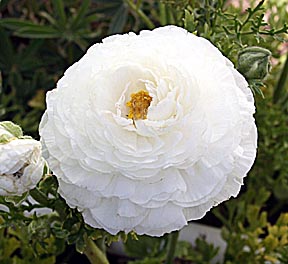
There are well over a dozen other buds starting to open. Many of the plants are still small and not showing any buds yet so it's looking like I may not have a massive single display but one that lasts for a long time as the plants nature at different times. Next year will be very interesting because instead of planting in October, the tubers will remain in the grown undisturbed. This should be the same as planting them in July, except that the tubers will never have been dried out. What this means for the 2012 season we'll have to wait to see.
NEW!!! April
7, 2011 Update:
The bed hit its peak on April 5th, two weeks earlier than last year.
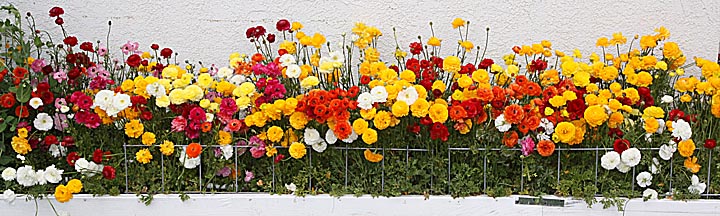
If it looks scraggly it's because I watered the previous day and many of the tall flower stems got bent over. Overhead watering is a problem with ranunculuses. The bed appears to be slightly overloaded with gold colors. I plan on pulling 10-percent of them to encourage several light yellow and lemon yellow plants to expand. As already mentioned, this bed is going to be naturalized, which means the tubers will not be dug, divided and replanted after storage. Left in the ground in this was, I anticipate that they will sprout earlier and develop heavier growth before they slow down over winter. What this will do to 2012's bed we'll all have to wait to see.
By
the way,
ever wonder where the odd name ranunculus came from? Rana is
the Latin root for frog. In their natural habitat many ranunculuses
grow in moist soil where frogs are abundant and were named ranunculus
because of the association. (I agree... this seems like a
stretch to me too.)
RANUNCULUS PICTURE GALLERY
Can't wait for Spring to see ranunculuses? Click on the thumbnails below to see larger images of the flowers. These will be added to and updated with better pictures (using my new Canon EOS 20D camera) as the 2005-2006 season gets started.





Return to my main site for more gardening pages or browse over 90 other topics: everything from electric rocket engines to Knitting Nancys.